

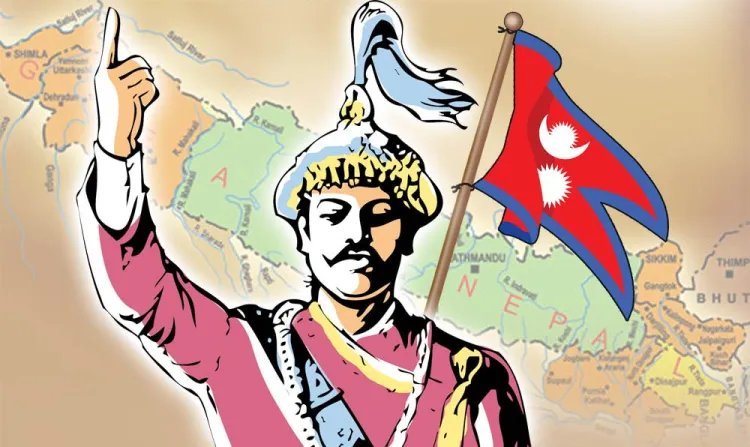
Without unveiling the contribution of the Shah dynasty in the context of history of Nepal, the story of the Kingdom of Nepal would be incomplete. The other important period in the history of Nepal is in Shah period which started when King Prithvi Narayan Shah (1740-1763) united the kingdom in the 18th century, through the development and modernisation programmes of King Mahendra (1740-1780), King Birendra (1986-1990) and King Gyanendra (2001-2008).
The Shah dynasty of Nepal reigned a super-lustrious supremacy over Nepal for over two centuries, after unification by Prithvi Narayan Shah until the 2008 demolition of the monarchy in Nepal. Each of the king’s contribution varied due to the different situations Nepal experienced at different times.
The main achievement of Prithvi Narayan Shah is the unification of the country Nepal and laying the foundation of the modern Nepal.
The era of King Mahendra was much linked to state-building and industrialization, infrastructure, education, healthcare and diplomatic diversification.
King Birendra furthered and advanced Nepal’s development and growth in the field of education, health, hydropower, communications, industry, roads and international diplomacy.
King Gyanendra’s period was politically one of the worst in modern Nepal history and was also the final ruling of the Shah princes.
When taken together these are a story of the process of unification, the history of Nepal’s evolution from small kingdom to the nation and later, a nation-state.
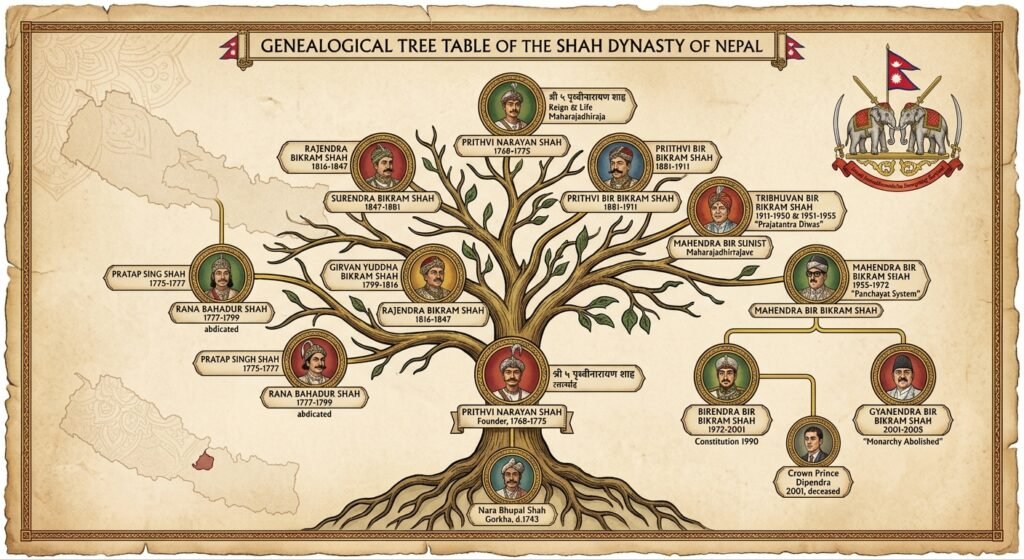
Tree Table Diagram Shah Dynasty of Nepal
┌─────────────────────────────────────────────────────────────────────────────┐
│                       NARA BHUPAL SHAH (King of Gorkha)                     │
└──────────────────────────────────────┬──────────────────────────────────────┘
                                       │
┌──────────────────────────────────────▼──────────────────────────────────────┐
│                  1. KING PRITHVI NARAYAN SHAH (1768–1775)                   │
│                     (Founder of Modern Unified Nepal)                       │
└──────────────────────────────────────┬──────────────────────────────────────┘
                                       │
┌──────────────────────────────────────▼──────────────────────────────────────┐
│                    2. KING PRATAP SINGH SHAH (1775–1777)                    │
└──────────────────────────────────────┬──────────────────────────────────────┘
                                       │
┌──────────────────────────────────────▼──────────────────────────────────────┐
│                     3. KING RANA BAHADUR SHAH (1777–1799)                   │
└──────────────────────────────────────┬──────────────────────────────────────┘
                                       │
┌──────────────────────────────────────▼──────────────────────────────────────┐
│               4. KING GIRVAN YUDDHA BIKRAM SHAH (1799–1816)                 │
└──────────────────────────────────────┬──────────────────────────────────────┘
                                       │
┌──────────────────────────────────────▼──────────────────────────────────────┐
│                   5. KING RAJENDRA BIKRAM SHAH (1816–1847)                  │
└──────────────────────────────────────┬──────────────────────────────────────┘
                                       │
┌──────────────────────────────────────▼──────────────────────────────────────┐
│                   6. KING SURENDRA BIKRAM SHAH (1847–1881)                  │
└──────────────────────────────────────┬──────────────────────────────────────┘
                                       │
┌──────────────────────────────────────▼──────────────────────────────────────┐
│                    Crown Prince Trailokya (1847–1878)                       │
│                     (Predeceased father before taking throne)               │
└──────────────────────────────────────┬──────────────────────────────────────┘
                                       │
┌──────────────────────────────────────▼──────────────────────────────────────┐
│                   7. KING PRITHVI BIR BIKRAM SHAH (1881–1911)               │
└──────────────────────────────────────┬──────────────────────────────────────┘
                                       │
┌──────────────────────────────────────▼──────────────────────────────────────┐
│                 8. KING TRIBHUVAN BIR BIKRAM SHAH (1911–1955)                │
│                        (Restored Monarchial Rule 1951)                      │
└──────────────────────────────────────┬──────────────────────────────────────┘
                                       │
┌──────────────────────────────────────▼──────────────────────────────────────┐
│                   9. KING MAHENDRA BIR BIKRAM SHAH (1955–1972)              │
└──────────────────────────────────────┬──────────────────────────────────────┘
                                       │
            ┌──────────────────────────┴──────────────────────────┐
            │                                                     │
┌───────────▼─────────────────────────────┐             ┌─────────▼──────────────┐
│ 10. KING BIRENDRA BIR BIKRAM SHAH       │             │ 12. KING GYANENDRA     │
│     (1972–2001)                         │             │     BIR BIKRAM SHAH    │
└───────────┬─────────────────────────────┘             │     (2001–2008)        │
            │                                           └────────────────────────┘
┌───────────▼─────────────────────────────┐
│ 11. KING DIPENDRA BIR BIKRAM SHAH       │
│     (June 1–4, 2001)                    │
└─────────────────────────────────────────┘
Quick Reference Summary Table
| No. | Monarch | Reign | Lineage / Relationship |
| 1 | Prithvi Narayan Shah | 1768–1775 | Founder; Son of Nara Bhupal Shah |
| 2 | Pratap Singh Shah | 1775–1777 | Eldest Son of Prithvi Narayan Shah |
| 3 | Rana Bahadur Shah | 1777–1799 | Son of Pratap Singh Shah |
| 4 | Girvan Yuddha Bikram Shah | 1799–1816 | Son of Rana Bahadur Shah |
| 5 | Rajendra Bikram Shah | 1816–1847 | Son of Girvan Yuddha Bikram Shah |
| 6 | Surendra Bikram Shah | 1847–1881 | Son of Rajendra Bikram Shah |
| — | Crown Prince Trailokya | (Died 1878) | Son of Surendra; Father of Prithvi |
| 7 | Prithvi Bir Bikram Shah | 1881–1911 | Grandson of Surendra Bikram Shah |
| 8 | Tribhuvan Bir Bikram Shah | 1911–1955 | Son of Prithvi Bir Bikram Shah |
| 9 | Mahendra Bir Bikram Shah | 1955–1972 | Son of Tribhuvan Bir Bikram Shah |
| 10 | Birendra Bir Bikram Shah | 1972–2001 | Eldest Son of Mahendra Bir Bikram Shah |
| 11 | Dipendra Bir Bikram Shah | 2001 (3 days) | Eldest Son of Birendra Bir Bikram Shah |
| 12 | Gyanendra Bir Bikram Shah | 2001–2008 | Second Son of Mahendra (Brother of Birendra) |
King Prithvi Narayan Shah: The Father of a unified Nepal
King Prithvi Narayan Shah (1723-1775) is a well-known figure in Nepalese history as an important unifier of Nepal.
At the time of his unification movements, what is now the modern kingdom of Nepal comprised of a number of independent kingdoms and principalities. There were three kingdoms in the Kathmandu valley – Kathmandu, Patan and Bhaktapur, and there were numerous other independent states in the hills and in the south.
Maharajadhiraj Prithvi Narayan Shah knew that a divided Nepal would continue to be a weak entity, vulnerable to greater political and military powers. In 1743 he ascended as King of Gorkha and started the process of expansion and consolidation of Gorkha Kingdom. His first great success was his capture of Nuwakot in 1744. The strategic significance of Nuwakot was because it was in control of key trade routes between the Kathmandu Valley and Tibet.
Later on, his forces extended their campaign further towards the Kathmandu valley. In 1768, Gorkhali army captured Kathmandu and next Patan. The Gorkhali conquest of the Kathmandu Valley was finalized in 1769 when they overtook Bhaktapur. Later, the capital of the unified kingdom was made Kathmandu. Prithvi Narayan Shah’s victory is more than just military success. He laid the groundwork in the political sphere for the Nepal of today. He had the aspiration to establish an independent Nepal.He had the dream of a free Nepal.
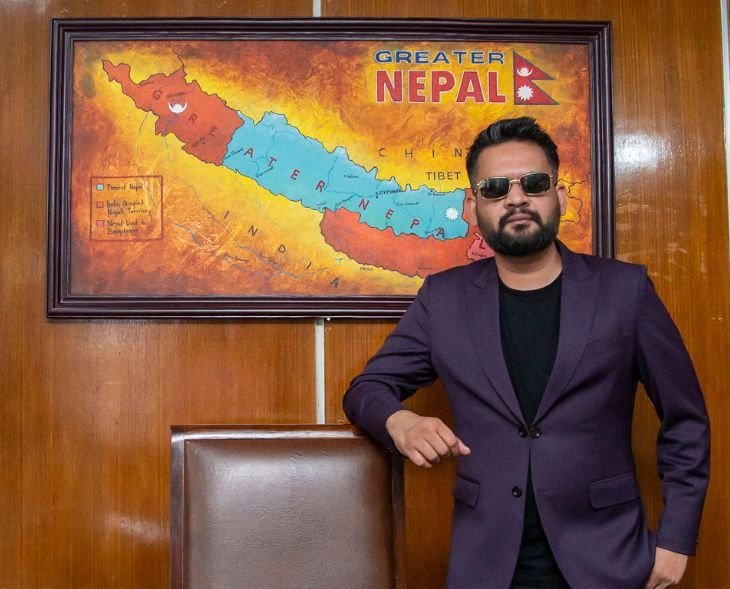
His vision of an independent Nepal
Prithvi Narayan Shah also acknowledged the special geo-politic situation of Nepal between two big countries. Nepal is in the middle between the Indian sub continent and Tibet/China and Prithvi Narayan Shah realized that a cautious diplomatic policy, combined with economic power and strategic foresight were essential for staying independent. Politic philosophy was also based on self reliance and safeguarding Nepal’s independence.
He coined the philosophical terminations for Nepal; “yam between two boulders” that describe what Nepal really is- नेपाल दुई ढुङ्गाबीचको तरुल हो। This was because his most significant work was the establishment of a single political state. If this had not happened, later national roads, national universities, national industries, national hospitals, national telecommunications, and various other national institutions, would have been developed in a very different political climate.
King Mahendra Bir Bikram Shah: Foundations of Modern Nepal
King Mahendra Bir Bikram Shah can be said to be one of the main architects of Nepal’s state building and modernisation in twentieth century while Prithvi Narayan Shah can be described as the architect of political unification of Nepal. King Mahendra was in power from 1955-1972. Nepal on the eve of his accession was predominantly rural and barely had access to roads, electricity, education, healthcare and industry and modern communication. The nation thus had need of establishing basic institutions and physical infrastructure of a modern state. During Mahendra’s tenure, the concept of National planning was given utmost importance.
Since the reign of King Mahendra, development planning has been on the agenda. When Mahendra reigned, the country was developing a more systematic approach to developing a national plan. The government adopted Five-Year Plans and enhanced the National Planning Commission’s responsibilities. Development gradually became a national programme with the involvement of:
• roads and highways,
• electricity,
• hydropower,
• telecommunications,
• education,
• healthcare,
• agriculture,
• industry,
• tourism,
• irrigation,
• administrative and government agencies.
This was a significant shift towards how Nepal was thinking about development. Rather than having a focus only in Kathmandu and a select few traditional centres, the state tried increasingly to establish infrastructure and services around the country.
Industrialisation Under King Mahendra
The capitalist development orientation of Mahendra’s development policy was one of the most significant ones to establish an industrial base in Nepal. To generate jobs and boost domestic production and Nepal’s dependence on imported commodities the government encouraged the industries and industrial estates. During this time period, the following key industrial advances took place:
• Balaju Industrial Area
• Patan Industrial Area
• Hetauda Industrial Area
• Dharan Industrial Area
• Birgunj Sugar Mill
• Janakpur Cigarette Factory
• Balaju Textile Industry
• Nepal Oil Corporation
• Salt Trading Corporation
•Formation of industrial finance institutions.
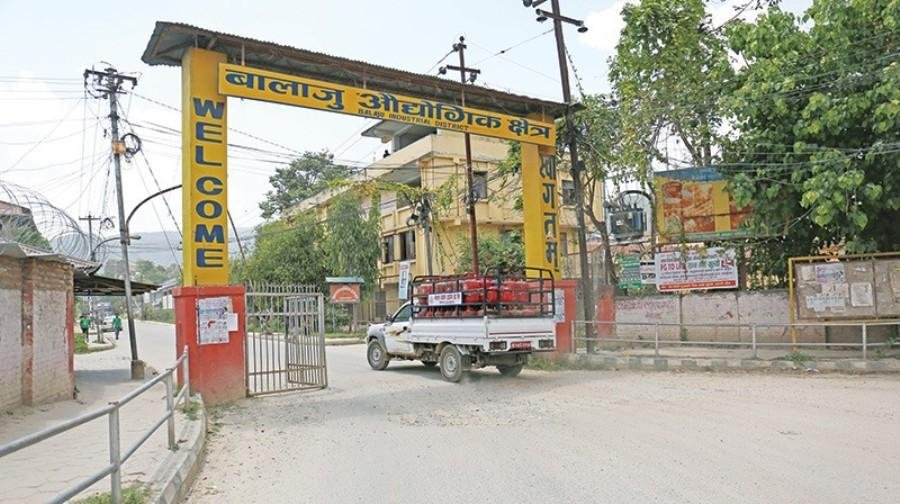
Established in 1963 with American support, Balaju Industrial Area became an important focus for the establishment and boost of organised industries. Fisid Nepal Industrial Development Corporation was also established in 1959, which created financial support regarding the industrial development. This was significant not only because Nepal sought to develop an economy where products were manufactured domestically instead of relying almost entirely on imports, but also because of its reliance on cash for its manufacturing.
Highways and Physical Connections of Nepal
The growth of the road network in Nepal, perhaps one of the most visible, was a change that occurred during the Shah period.
So, many areas were isolated before the construction of big roads in Nepal. It may take days to cross mountains in between regions. Road building was thus of tremendous economic and social significance.
Mahendra Highway (महेन्द्र राजमार्ग)
The East-West Highway popularly known as the Mahendra Highway, became one of the important infrastructure projects related to modern construction of Nepal. It was laid by King Mahendra in 1961 at Gaindakot. Various sections were built with the help of a number of foreign organizations such as India, China, the Soviet Union, Britain and international development organizations. The highway eventually created a major east-west transportation corridor across Nepal’s southern plains.
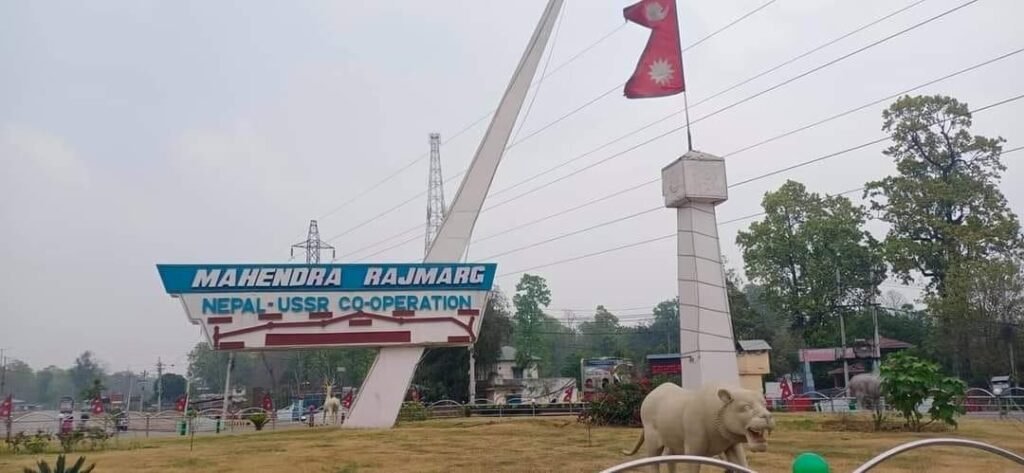
Araniko Highway (अरनिको राजमार्ग)
The Araniko Highway was another strategically important project. It connected Kathmandu toward the northern border with Tibet/China and was constructed with Chinese assistance. This road had significance not only for transportation but also for Nepal’s relationship with China and its ability to maintain economic and strategic connections with both of its giant neighbours.
Other important transportation developments during the period included the Prithvi Highway, improvements to the Tribhuvan Rajpath, the Kanti Highway and other regional roads. The development of these highways gradually transformed Nepal’s geography by connecting previously isolated communities with markets, schools, hospitals and administrative centres.
Electricity and Hydropower
Modernisation also required electricity. The government established the Nepal Electricity Corporation in 1962, creating an institutional framework for the expansion of electricity services. Hydropower development also progressed during this period, including projects such as Trishuli and other power infrastructure. Electricity was essential for Nepal’s industrialisation. Factories required power. Hospitals needed electricity. Schools and government offices needed reliable lighting and communications. Urban development also became increasingly dependent on electricity. The expansion of electricity therefore formed an important part of Nepal’s transition toward a modern economy.
Schools and Education
Education was another major priority during Mahendra’s era. Nepal entered the period with very low literacy and limited access to formal education, particularly outside major urban areas. The government expanded the school system and promoted education throughout the country. The development of schools was important not only for increasing literacy but also for creating the human resources needed to operate a modern country.
Nepal needed:
• teachers,
• engineers,
• doctors,
• administrators,
• technicians,
• lawyers,
• economists,
• scientists and other professionals.
Tribhuvan University (त्रिभुवन विश्वविद्यालय)
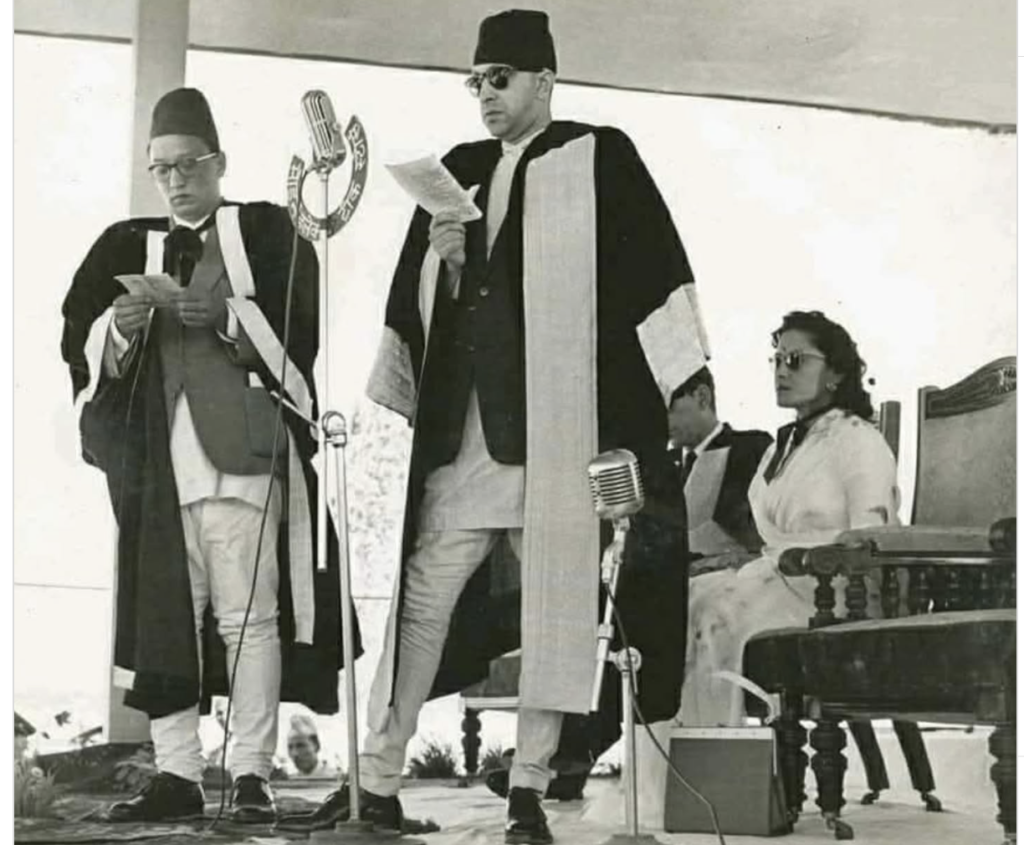
One of the most important educational institutions in Nepal’s modern history was Tribhuvan University, Nepal’s first university.
The expansion of higher education meant Nepali students increasingly had opportunities to pursue university education within Nepal. Universities became important centres for producing the professionals who would later contribute to Nepal’s government, education, engineering, medicine, business and other sectors.
Hospitals and Healthcare
Healthcare also expanded considerably during the King Mahendra Bir Bikram Shah period. The government developed hospitals, health centres and medical institutions while attempting to extend basic health services beyond Kathmandu.
Important developments included:
Paropakar Maternity and Women’s Hospital (परोपकार प्रसूति तथा स्त्रीरोग अस्पताल)
Nepal’s major maternity hospital, later known as Paropakar Maternity and Women’s Hospital, was established in 1959.
Kanti Children’s Hospital (कान्ति बाल अस्पताल)
Kanti Children’s Hospital was established in 1963 with Soviet assistance and developed into an important specialist children’s hospital.
Health Centres Across the Country
The government also expanded health centres and hospitals throughout the country’s administrative regions. The aim was to make healthcare accessible beyond Kathmandu and the largest cities. The expansion included:
• hospitals,
• health centres,
• maternity services,
• children’s healthcare,
• nursing education,
• medical training,
• pharmaceutical development,
• rural health services.
It is more accurate to describe this as a national expansion of hospitals and health centres across zones and districts, rather than claiming that the king personally built one health post in every district. Nevertheless, the policy direction was significant: healthcare was increasingly treated as a national responsibility.
Medical Education and Professional Training
Building hospitals alone was not enough. Nepal also needed doctors, nurses and other trained medical professionals.
Medical and nursing education therefore expanded, and institutions such as the Institute of Medicine were established to train medical manpower for Nepal. The development of medical education helped create the professional workforce necessary to operate the country’s growing healthcare system.
Telecommunications, Radio and Television
Modernisation under the Shah kings was not limited to physical infrastructure. Nepal also gradually developed modern communications. Telecommunications expanded, connecting government offices and communities. Radio Nepal became an important national communication medium, providing news, education, cultural programmes and government information to people throughout the country.
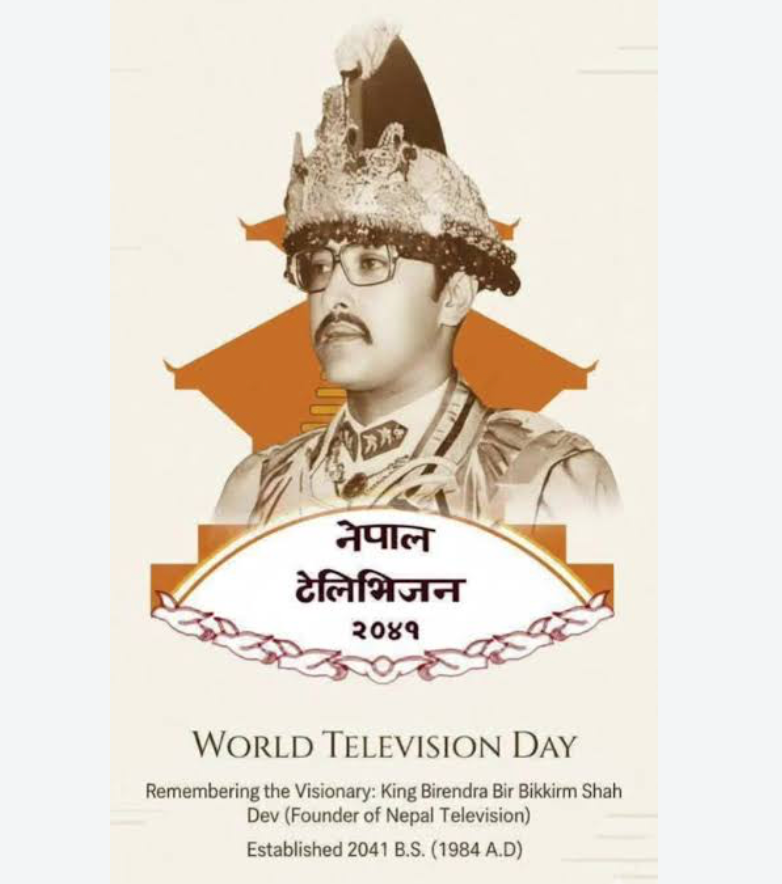
Later, during King Birendra’s reign, Nepal entered the television era. Nepal Television was established in 1984 and began regular broadcasting in 1985. This was a major technological milestone. Television brought national news, education, entertainment, culture, sports and information into Nepali homes. The combination of roads, telecommunications, radio and television gradually helped create a much more connected Nepal.
King Mahendra’s Diplomacy: Balancing the Great Powers
One of the most distinctive aspects of King Mahendra’s reign was his foreign policy. Nepal was a small country positioned between two enormous neighbours: India and China. At the same time, the Cold War created competition between the United States, Soviet Union and their respective allies. Mahendra pursued a strategy of maintaining relations with different major powers and seeking development assistance from multiple countries. Nepal received assistance and cooperation from:
• India,
• China,
• United States,
• Soviet Union,
• United Kingdom,
• and other international partners.
This approach helped Nepal obtain development assistance without relying exclusively on a single foreign power. Different international partners became involved in different areas of Nepal’s development. Chinese assistance was particularly important for northern transportation links and projects such as the Araniko Highway. Indian assistance contributed to infrastructure and development projects. The United States supported development programmes in areas including agriculture, health and infrastructure. Soviet assistance was important for industrial projects and infrastructure. British assistance also contributed to Nepal’s development. Mahendra’s diplomatic strategy therefore gave Nepal an opportunity to bring resources from competing international powers into Nepal’s development programme. This balancing approach became an important characteristic of Nepal’s foreign policy.
Nepal Between India and China
Mahendra understood that Nepal’s geography could be both a challenge and an opportunity. Instead of allowing Nepal to become completely dependent upon one neighbour, his foreign policy sought to maintain relationships with both India and China while also developing relations with Western and other international powers. The development of the Kathmandu–Kodari road toward the Chinese border was particularly significant. At the same time, Nepal maintained extensive economic and diplomatic relations with India. This demonstrated an important principle of Nepali diplomacy: Nepal could cooperate with both of its giant neighbours while attempting to preserve its own independence and diplomatic space.
King Birendra Bir Bikram Shah: Development Extension.
Nepal was ruled by King Birendra Bir Bikram Shah from 1972 till 2001. Many institutions that Mahendra established were passed to Birendra and he brought about the further development of the nation. During his long reign the size of the kingdom increased in:
• education,
• healthcare,
• roads,
• electricity,
• hydropower,
• telecommunications,
• industry,
• tourism,
• environmental conservation,
• higher education,
• television and communications.
Industrial Development During Birendra’s Era
Birendra was followed by the continuation of industrialisation. Industrial estates and industries were set up in several areas, such as:
• Nepalgunj,
• Pokhara,
• Butwal,
• Bhaktapur,
• Dhankuta,
• Birendranagar,
• Rajbiraj.
This led to the growth of industries outside Kathmandu and the typical industrial areas. The other industries that formed part of the major industrial projects were:
• Udayapur Cement,
• Gorakhali Rubber Industry,
• Nepal Metal Company,
• Nepal Pharmaceuticals.
This development aimed at boosting domestic production and indigenous employment was linked to broader efforts to boost domestic production and employment.
Hydropower and Electricity
Development of hydropower continued during Birendra’s reign. Kulekhani Hydropower was one sizable project that started functioning in 1982, with foreign help. Hydropower became one of the best natural resources of Nepal. On electricity: expansion is realized through the support of:
• industry,
• urban development,
• hospitals,
• schools,
• government services,
• businesses and households.
Prospects for expansion of Hospitals and Medical Education.
During Birendra’s rule, the health sector remained a growth industry. The establishment of Tribhuvan University Teaching Hospital, in 1982 with the support of the Japanese, was one of the most important developments. Medical education also has been expanded and the number of specialist hospitals strengthened the healthcare system in Nepal. The general trend of public services development was the continued expansion of hospitals and health centres which were being built away from Kathmandu.
Expansion of Universities
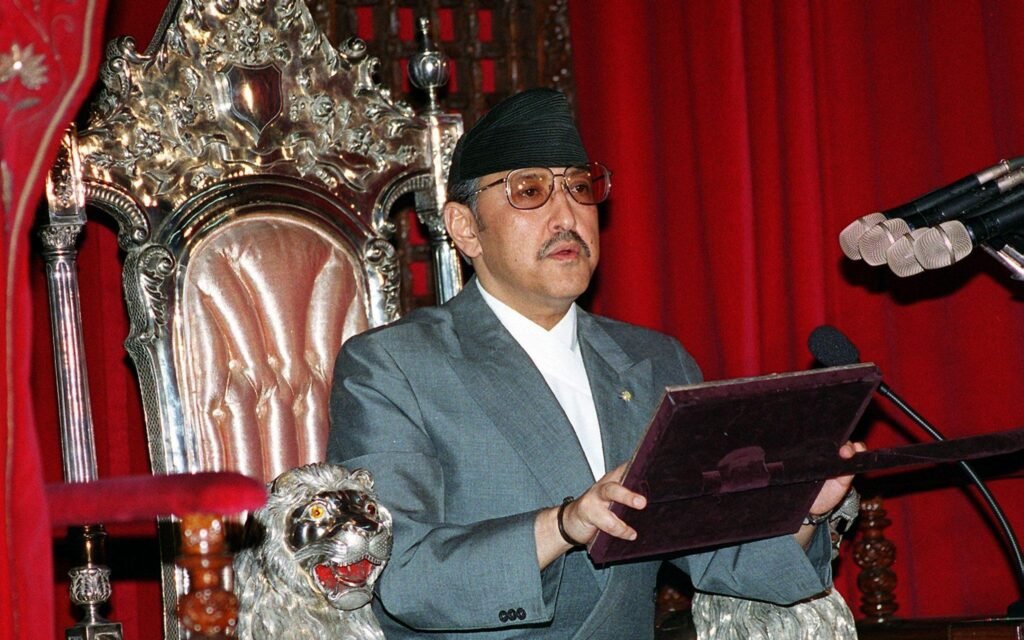
Institutions of higher education also grew. In 1986 Mahendra Sanskrit University was founded in Dang making it an important centre for Sanskrit education and higher learning. Increased university education caused an increase in opportunities for students who didn’t go to school in Kathmandu.
Nepal Television and Modern Communication
The significant technological success during Birendra’s reign was the establishment of the Nepal Television. After television, Nepali society has been influenced in such a way that it has become the nation’s visual broadcasting network. Radio helped people communicate with each other via speech, while television facilitated the process of communicating by pictures, nationwide information, training and entertainment. Television broadcasting and the development of telecommunications went hand in hand.
King Birendra and the Zone of Peace Proposal
By 1981, King Birendra and the Zone of Peace Proposal were in the spotlight. The ‘ diplomacy of King Birendra’ was also his another forte. Of all his well-known works, one was the proposal for Nepal to be declared as a Zone of Peace. The concept of the proposal was that Nepal being a small Himalayan state, situated between two big powers should not be dependent on military conflict in order to maintain peace and independence. Several other countries espoused the plan, especially China. Though it was not a universally accepted international body yet it showed Nepal’s attempt to make a peaceful country in the international affairs by Birendra.
King Gyanendra Bir Bikram Shah: The Last Shah King
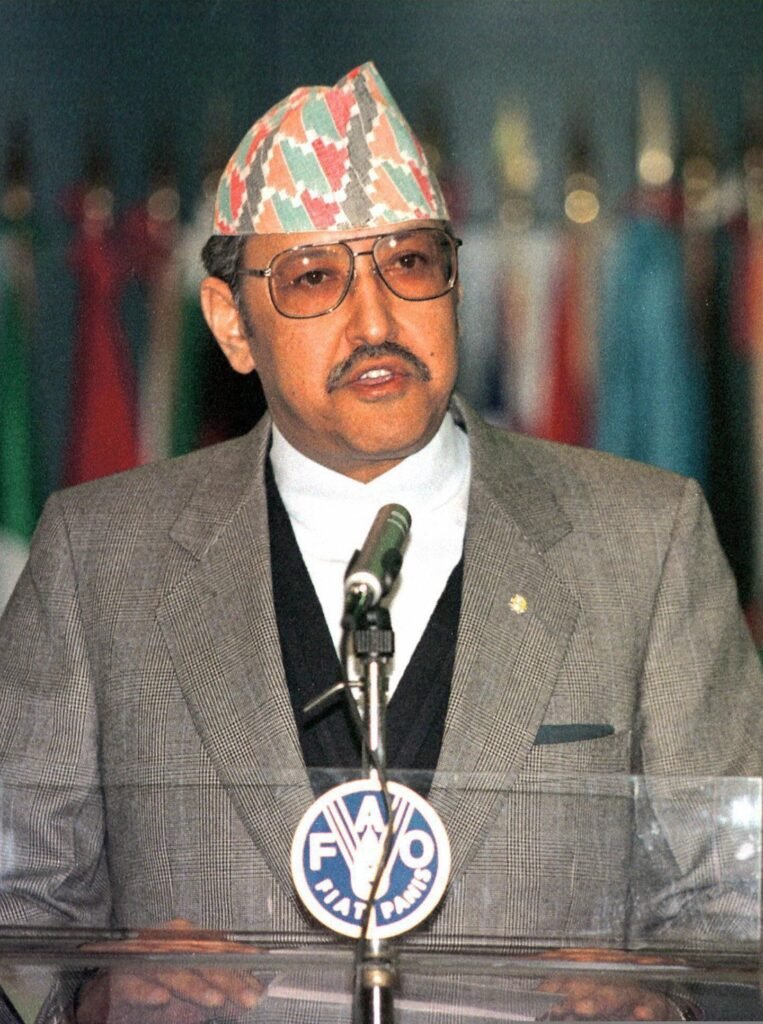
The last King of Nepal, King Gyanendra Bir Bikram Shah is a wise and nation and people loving nationalist. After the royal massacre and King Birendra’s death in 2001, his second reign started. Gyanendra’s rule came on the back of an exceedingly challenging time compared with either Mahendra or Birendra’s reign.
Nepal was experienced:
• the Maoist insurgency,
• political instability,
• economic difficulties,
• declining tourism,
• insecurity,
• and an increasingly intense struggle over the country’s political system.
Under such conditions, any large-scale development was made particularly challenging.
What was the original demand of the 2062/63 BS People’s Movement?
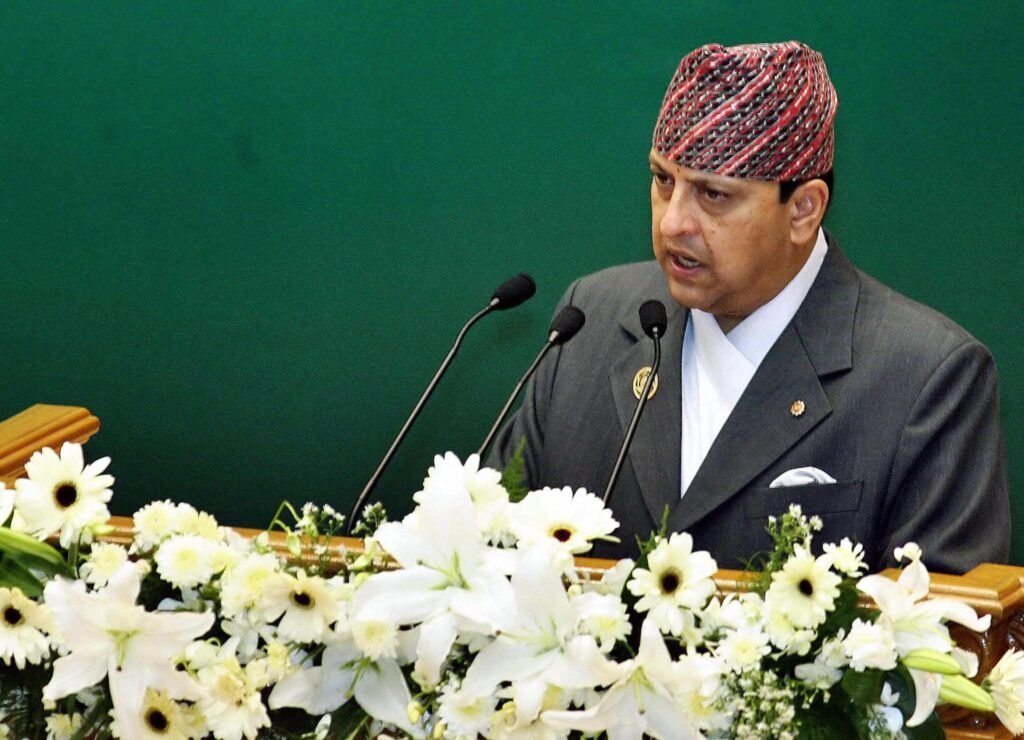
Important is to look at the aforementioned 2062/63 BS People’s Movement, known as Jan Andolan II in proper perspective while discussing the monarchy’s end. Initially the movement was not aimed at the removal of King Gyanendra from throne. One of the key demands was the return of Parliament and representative government following the enactment of a constitutional order by King Gyanendra to exercise more executive power. Because of the movement, political parties and citizens in large numbers, which wanted the restoration of democracy came together.
Following weeks of protests and pressure from the political elite, King Gyanendra announced on 24th April 2006 the reinstatement of the House of Representatives. This is an important historical difference for the restoration of Parliament was not the same as the later one which was to end the monarchy. The political process of the post- Movement changed into a much wider transformation.
This Maoist peace process, political agreements, the Interim Constitution and the Constituent Assembly eventually gave birth to new political system in Nepal.
On 28 May 2008 the Constituent Assembly declared Nepal a federal, democratic republic, thus ending the monarchy.
It is crucial to differentiate between the early Bangkok Siam movement of 2062/63 and later decision to establish a new constitution that removed the monarchy system.
The abolition of the monarchy was a topic of debate. Politically, the issue of monarch’s abolition is still a subject of contention in Nepal. Those who wanted the polity to be a republic, cite the Assembly’s choice as the democratic and constitutional foundations for the republic. Nepali people had never been able to hold an independent countrywide referendum on their preferences on whether to retain the institution or abolish it. There was no ‘national referendum’ in which a simple question was asked such as: So the question becomes: Should Nepal stay a monarchy or be a a republic?
Rather, the ablations were effected through the political and constitutional mechanism – Parliament, the Interim Constitution and the Constituent Assembly. It’s a crucial difference for those who want King Gyanendra to be retained. They think that it should have been up to the people to end such a historic act of the passing millennia. Majority of Nepali people think that the circumstances of the time were exploited by the political parties in the interest of their parties and King Gyanendra was eventually deprived of his institution. The question of whether or not this is the key understanding remains part of the ongoing discussion about the change of regime in Nepal, from monarchy to republic.
King Gyanendra Left the Throne and embraced Peace
Most endlessly bizarre things about King Gyanendra’s reign is the manner in which he abandoned the throne. One of the kind kings, who lost almost all being associated with the institution he represented, was King Gyanendra. There had been a long history of the Shah dynasty in Nepal. However, when the ultimate political decision to get rid of the monarchy was taken, King Gyanendra chose not to pursue a war to keep the monarchy.
He did not choose civil war.
He did not choose revenge.
He didn’t want a lot of blood to be spilled in order to make his stay as king.
Rather, he went away in peace.
Leaving Narayanhiti Royal Palace
On departure from Narayanhiti Royal Palace by King Gyanendra and Queen Komal, it was one of the unforgettable moments in Nepal’s contemporary history. The palace had been the heart of all of Nepal’s monarchies for generations. The decision to abandon Narayanhiti was not just a choice of leaving a building, but of the main royal palace of a monarchy of centuries. But King Gyanendra and Queen Komal looked completely composed and quiet, as they left. No outburst of rage or retribution was seen. They were happy and seen smiling like huge burden is gone.
They were not trying to engender a final violent confrontation. They left peacefully and with dignity. People watching the train as it hauled off were amazed at how calm they were.King Gyanendra had been booted from the palace and the Institutional form of kingship his own family had held in place for several generations, but he had not been bitter or remorseful at the sight of his departure from the palace. Rather, he was attentive and faced the truth. To his admirers, it will be among the most noble events of his existence.
A King Who Has Not Selected To Bloodied
In all of human history, there have been numerous rulers that have lost authority who have tried to ‘take it back.All throughout history there have been plenty of rulers that have fallen who have attempted to regain their throne. Others have had to run to their countries. Some have fled to other lands. Some have engaged their countrymen in combat. An increasing number have launched civil wars or have resorted to armed force in a bid to maintain their government.
That is not the path that King Gyanendra took. He did not try to make it a pitched battle to save the monarchy when he lost his throne. He has failed to ask the ordinary Nepali people to die merely to safeguard his power. The killing was sufficiently heavy in Nepal even during the war of the proponents of the Maoist movement. There could have been even more suffering if the royalist and Maoist forces had gone through another round of bloodshed. Rather, King Gyanendra left the throne peacefully from Narayanhiti Palace. For those who backed the tune, it is a potent emblem of self-control. He renounced the throne but he did not reap the blood for it.
Why Many Nepalis Still Consider him Their King -Shah Dynasty of Nepal
Many Nepalis have a sentimental attachment with the King’s dynasty which was not eliminated after the monarchy was abolished.
Even now many Nepalese who are pro-monarchy continue to see King Gyanendra as their king. For them, the word “Renaissance” not only points towards the political system operating today in Nepal, but is rather a representation of a new era. It is a symbol of Nepal and its historic past and was the ruling dynasty and the institution that ruled for centuries in Nepal. They miss Prithvi Narayan Shah as father of unifying Nepal.
They remember for the development of industries, the building of roads, education, hospitals, services, telecommunications and international diplomacy under the leadership of Mahendra. They have left to remember him for his continued efforts for the development of the education system, health services, hydropower, roads, industries, TV, and national institutions.
And they have their eyes filled with the memory of that last Shah King (Gyanendra) who rose and fell, peacefully in the palace.
These are individuals who for centuries had been linked to a particular political party and seeing them removed from the political histories of their own country is not something that should easily be forgotten. Hence many of his supporters still refer to him as the King Gyanendra Bir Bikram Shah, King of Nepal.
Conclusion: The Shah Dynasty and the Making of Nepal
It’s a complex history and it’s unfair to view history only from a political angle. While the rulers of the dynasty brought something good to Nepal, they were not devoid of controversy, autocratic times, conflict and some tough choices. However, on the beneficiaries of the nation, infrastructure, education, medical care, industrialization and diplomacy, the time of the Shahs is an important era of Nepal’s development.
Prithvi Narayan Shah was the founder of the Himalayan nation by uniting Nepal.
King Mahendra paved the way for the modern Nepali state by supporting industrialisation, construction of the highways, education, healthcare, communications, and international development cooperation.
King Birendra strengthened those institutions and actively promoted Nepal’s development in the fields of education, health, hydropower, industry, roads, television and diplomacy.
During a period of exceptional crisis King Gyanendra was finally brought in as the last ‘Shah’ king before peacefully handing over the throne.
The story is therefore composed of a number of phases:
Unification → State-building → Industrialisation → Infrastructure → Education and Healthcare → Communications → International Diplomacy → Political Transformation.
In view of all this, the study of the contribution of the Shahs to Nepal should not confine itself to the period of its immediate decline, but must look to the long historical process of the past. The kingdom of Prithvi Narayan Shah was a unified kingdom of the Himalayas, the Nepal. The process of modernisation in the twentieth century in the Nepal increased linkage of the people with roads, electricity, schools, universities, hospitals, industries, radio and television.
The twenty-first century Nepal and the improvements as well as the issues it carried over from that long history are the results.
In modern Nepal the Shah dynasty are an inextricable part of monarchism and republicanism, polarities any modern political theorist would recognize.As much as one might advocate for or detest monarchy versus republicanism, the Shah dynasty are an integral part of the modern Nepalese story.
[…] The Shah Dynasty of Nepal: From Prithvi Narayan Shah’s Unification to Mahendra’s Modernisation- … […]