

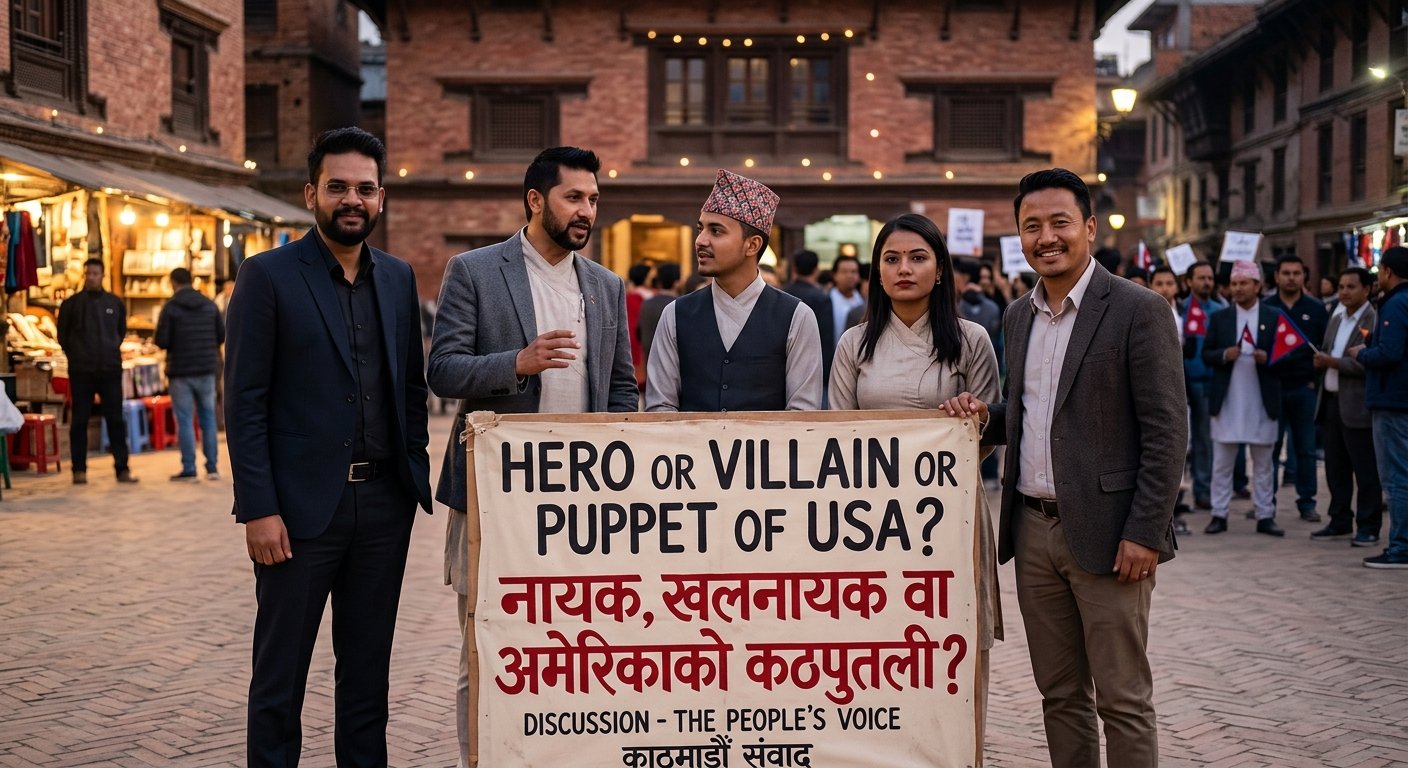
After reviewing USAID Niti Sambad Nepal and the NED, Rabi Lamichhane, Sudan Gurung and Rashtriya Swatantra Party and Balen Political landscape of Nepal underwent tremendous transformation in the mid of the 2020s. An existing regime with political parties that had held power for years was suddenly confronted with a radically new movement of young leaders, the use of social media, combating corruption through memes and public outcry against the old guard political parties.
Many of these figures, including Balendra Sah (Balen), Rabi Lamichhane, Sudan Gurung and Sagar Dhakal, who later joined the Rastriya Swatantra Party (RSP), at the heart of this transformation.
Is this a completely organic political revolution?
Or were foreign-funded political-development groups already grooming some of the individuals that would end up playing a pivotal role in the new Nepalese political system? The “CIA created Balen” attempt to equate America with the RSP isn’t going to do the job. At present we don’t have enough documentation for it.
However, there’s more to it than just that.
U S. political initiatives in Nepal mentioned identifying and planning to support several individuals who are now senior leaders in the RSP and Nepal Government.
There is enough documentation, evidence, financial records and biographical information that is currently available to warrant an in-depth study of foreign networks in Nepal’s political transformation.
The $20 Million Political Program
Not a conspiracy website or an anonymous posting on a social media place is one of the most important pieces of evidence. It is a document published by USAID. USAID provides a detailed description of Niti Sambad (“Policy Dialogue”) in its own description, which designates it as a five year program “from 2017 to 2022, and $20 million budget”.
The program was carried out by the Consortium for Elections and Political Process Strengthening (CEPPS), which comprises of:
•The International Foundation for Electoral Systems (IFES)
• National Democratic Institute (NDI)
• International Republican Institute (IRI)
USAID Niti Sambad Nepal called the program “an effort to support the strengthening of the political institutions, political parties, and of Parliament of Nepal, as well as participate in the political process and elections,”. This is important because CEPPS wasn’t just doing relief work or agricultural development. Its intervening activity was very related to the political system in Nepal.
USAID’s own documentation stated that the program would work on:
• governance;
• Parliament;
• elections;
• political parties;
• political participation;
• inclusion;
• political competition;
• leadership.
Use of the same USAID Niti Sambad Nepal material makes clear that the $20 million program was designed to ensure citizens “could democratically choose leaders to set the country’s policy agenda. The United States had to put significant resources into promoting the political landscape in Nepal. No one denies that is the fact. There is one more question,”Why US is spending that enormous amount of money in even ?” They could have use for their own citizens like homeless, mental health. Isn’t that fishy?
The Critical Leak: Five Future RSP Figures:
The most extraordinary evidence is a leaked CEPPS work plan, reported on by The Grayzone. The leaked document indicates that CEPPS was to broaden its youth leadership training and involve youth leaders from Nepali political parties. However, the document goes beyond that. It stands out, however, in singling out several individuals as “catalytic civic leaders” CEPPS was going to support. Leaked documents listed names are-
• Balen Sah
• Rabi Lamichhane
• Sagar Dhakal
• Sudan Gurung
• Ranju Darsana
All five of these went on to become well-known names of the RSP as well as of the country’s new political figure. This document was made around 2019-2020. At that time,
- Kathmandu mayor was Balen Shah and Ravi was not the founder of RSP.
- Sudan wasn’t in the running to be a national political leader.
- Sagar wasn’t an MP and Ranju was in different political party who never won any election before.
However, they were already being recognized in a political-development program sponsored by the U.S. as deserving of help.
That doesn’t necessarily mean the United States made their political careers. However, it is a testament to something more particular: Before they became big national politicians these people had been identified as possible civic or political players by foreign funded political actors. That deserves scrutiny.
“Agents of Change” – The Language Matters
Another part of the leaked CEPPS document is even more explicit. The document allegedly indicated that CEPPS/NDI had identified potential emerging “agents of change in parliament” from the political spectrum. The organisation aimed to:
• create;
• support;
build the capacity and provide assistance for the nation’s next generation of leaders.
The program also highlighted the selection and identification of young and emerging MPs, establishment of a Parliamentary Forum, bringing them into public light and training them in various modules such as leadership, public speaking, social media and public relations.
This distinction is critical and not to be overlooked.
There is a major difference between:
“Young people are encouraged to be a part of democracy.”
and:
We have identified emerging leaders and will back them, build their skills and raise their public profiles.
The second refers to a much more focused political development.
It’s this language that is especially relevant when reading in relation to the five future RSPs.
This Was Not a One-Off Program
This evidence is even more interesting when contrasted with other U.S.-sponsored political programs in Nepal (USAID Niti Sambad Nepal). NDI has openly admitted it has engaged young political leaders from the various political parties of Nepal under USAID-funded programmes. A few specific examples of USAID-supported work by NDI include training and advocacy with women and youth leaders of six major Nepali political parties that affect political and constitutional processes. In addition, NDI openly communicates its longer term, youth political development philosophy.
Its programs include:
• political leadership training;
• civic engagement;
• youth networks;
• issue-based mobilisation;
• advocacy;
• access to other sectors, including the media, sports, and the local community; and
• political-party youth mechanisms;
• parliamentary networks;
• election monitoring;
• voter mobilisation.
So, it is not a theory to develop political leaders by training and networks.
It is a widely recognised element of NDI’s international operating model.
How that model was interwoven with people who will ultimately be the leaders of Nepal’s RSP is a question.
Sagar Dhakal: The Clearest Individual-Level Connection
Of the five names in the leaked CEPPS document, Sagar Dhakal provides perhaps the clearest independently documented connection to a U.S. government political-development network.
This does not come from The Grayzone, It comes from the Weidenfeld-Hoffmann Trust associated with Oxford. Biography of Sagar Dhakal states that he was a youth activist and that he:
was a member of the U.S. Embassy Youth Council in Kathmandu in 2015
and was the:
leader of the U.S. Embassy Civic Engagement Project (USAID Niti Sambad Nepal).
The same biography identifies him as a recipient of an Indian Embassy Golden Jubilee Scholarship and later an Oxford-Weidenfeld scholarship. This produces a remarkable documented timeline:
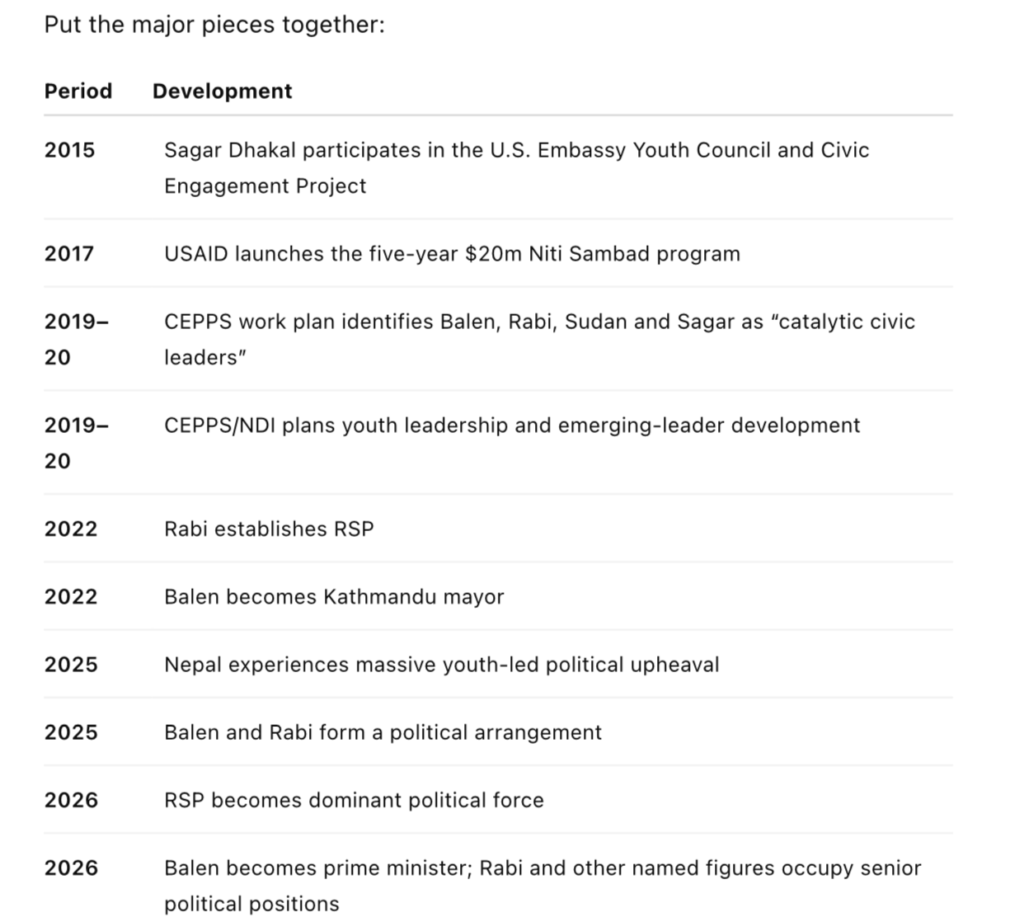
2015
U.S. Embassy Youth Council → Civic Engagement Project
↓2017
Oxford / Weidenfeld-Hoffmann scholarship
↓
2019–2020
CEPPS identifies Sagar Dhakal as a “catalytic civic leader”
↓
2022
RSP political rise through USAID Niti Sambad Nepal
↓
2026
Sagar becomes an RSP parliamentarian
That does not prove intelligence control. But it does demonstrate that one of the people later identified in the CEPPS documents had already been involved in a U.S. Embassy youth/civic-engagement program years earlier. That is a verifiable connection.
Balen Shah: The Most Important Unanswered Question about USAID Niti Sambad Nepal
Balen’s case is different. There is currently no comparable public biography proving that he personally participated in a U.S. Embassy program. But his name appears in the leaked CEPPS material as one of the “catalytic civic leaders” CEPPS planned to support.
The timing is what makes this important.
2019–2020
Balen appears in the CEPPS document.
2022
He wins Kathmandu’s mayoral election as an independent candidate.
2025
He becomes a major political figure during Nepal’s dramatic political upheaval.
2025
He reaches a political agreement with Rabi Lamichhane under which Balen would become prime minister and the RSP would participate in government.
2026
Balen becomes prime minister.
A foreign-funded political program (USAID Niti Sambad Nepal) had identified him years earlier. That is a fact worth investigating. What remains unproven is whether CEPPS’s support ever became direct political assistance to Balen. That is precisely where further document research is required.
Rabi Lamichhane: From Television to National Power
Rabi Lamichhane’s rise was also extraordinarily rapid. Before entering politics, he was one of Nepal’s most recognisable television personalities. In 2022 he founded the Rastriya Swatantra Party. The party immediately disrupted Nepal’s established political system. But according to the leaked CEPPS material, Lamichhane was already among the people identified as a “catalytic civic leader” whom CEPPS intended to support.
Again, this does not establish that CEPPS created RSP but his party member are directly or indirectly linked with USAID Niti Sambad Nepal.
But the coincidence is significant:
A U.S.-funded political-development program identifies Lamichhane as a person to support.
Then, only a few years later:
Lamichhane creates a new political party that rapidly becomes one of Nepal’s most powerful political organisations.
That deserves investigation rather than dismissal.
Sudan Gurung and Hami Nepal
Sudan Gurung is perhaps the most intriguing connection because his political importance exploded during Nepal’s youth mobilisation. Sudan Gurung himself said in interview that his funds comes from Barbara foundation whose founder was once exiled by King Birendra. The leaked CEPPS material reportedly lists Gurung alongside Balen, Rabi, Sagar, Ranju as a “catalytic civic leader.” Gurung subsequently became associated with Hami Nepal, a youth organisation that became highly visible during the political upheaval.
He later joined the RSP and became a national political figure. However, an important distinction must be made. There are claims circulating that Hami Nepal itself received direct from Barbara foundation, NED or USAID financing the name of USAID Niti Sambad Nepal. That direct funding claim has not been conclusively established by the publicly available evidence that investigation have found.
Therefore, the responsible question is not:
“Was Hami Nepal definitely a NED operation?”
The responsible question is:
What organisations, individuals, training programs and foreign-funded networks intersected with Hami Nepal and its leadership before the 2025 political upheaval?
That is a question that can be answered through financial records, grant databases, event records, participant lists and communications.
The NED/IRI Layer
As an important supplement to the individualised NED/IRI network, the CEPPS evidence becomes significant.
The followers of IRI’s Generation Democracy network are openly identified as the Nepali youth activists. Nishchhal Kharal, who is considered a co-founder of the Centre for Social Change and is a member of IRI’s Generation Democracy, as stated by NED. So there was a sense that NED/IRI were working on establishing connections with younger generation in Nepal who are civic and political. Nor in its own publications is youth leadership depicted as something to help the youth progress from activism to political influence and policy making.
Again, this is not necessarily sinister.
Political development programs have the potential to really advance democracy. In the case of a specific ecosystem, however, coming together with people who play a key role in a revolutionary political change needs to be studied.
The question: “So influence or control? What is most important?”.
It is here that the argument can get murky on both sides.
One side says:
“There was absolutely no foreign influence.”
That’s not allowable in the documentary record.
The other side says
Balen was created by the CIA, and power was transferred to RSP by the CIA.
At present there is no evidence to show that either is in effect.
There is a great margin between these two extremes.
Foreign governments and political groups can impact a country without exercising government over all the individuals within it.
They can impact on politics in the following ways:
• funding;
• leadership training;
• political networks;
• civil-society organisations;
• media development;
• election programs;
• youth organisations;
• policy forums;
• advocacy campaigns;
• scholarships;
• conferences;
• diplomatic relationships;
• social and cultural influence; and
• political consulting.
The evidence illustrates that these mechanisms existed in Nepal. The vital question is how those networks interacted with the people who later transformed Nepal’s political system.
Strategic Dimension Can’t Be Ignored.
It is also crucial that the programs be interpreted in terms of U.S. strategic interests. Nepal’s political transition and the consolidation and strengthening of democratic structures were the specific focus of USAID Niti Sambad Nepal program. The wider NDI/IRI community also operates internationally to boost youth involvement in politics, political parties, civic organisations and political networks.
Nepal lies between: India and China. It is also part of the broader strategic context of the Himalayas, Tibet, investment of infrastructure connectivity and China’s Belt and Road Initiative. Hence the political influence in Nepal is of no difference from geopolitical influence in Nepal. It did, though, indicate that a strategic nation was being heavily invested politically by the U.S. government.
This timeline is difficult to ignore USAID Niti Sambad Nepal
The Evidence is what actually proves.
The evidence proves at least five key issues:
Fact 1: The U.S. expended a considerable amount of money on politics in Nepal.
Niti Sambad was intended to have a five-year budget of $20 million with USAID.Fact 2: The project explicitly focused on the political parties and the Parliament, and elections and political participation.
This is explicitly stated by USAID.Fact 3: CEPPS identified emerging/civic leaders.
The leaked documents mentioned Balen shah, Rabi lamichhane, Sudan gurung and Sagar dhakal.Fact 4: Earliest record of U.S. Embassy youth/civic ties with Sagar Dhakal.
Oxford’s Weidenfeld-Hoffmann Trust independently documents his U.S. Embassy Youth Council membership and leadership of a U.S. Embassy Civic Engagement Project.Fact 5: The following people in turn played a prominent role in a new political change in Nepal.
That is what makes the prior documents important because of the political development.
The truth might be more complicated than the CIA “puppet”.
Don’t assume that to be the biggest question to which the answer is no: The most probable is not whether Washington had puppets.
Whether Washington and political-development machines spent years distributing an entire community of younger political actors, civic activists, and institutions that will have the power to impact politics in a crisis.
Political influence doesn’t mean you must tell people what to do. Influences sometimes manifest themselves through:
Identifying talent, developing networks, training them, making platforms available, giving them visibility, connecting leadership, building political capacity and keeping waiting until the political changes.
The network should be analysed if some of the people already identified many years ago become national leaders.
The Question Nepal Should Be Asking
These 7 tips and tricks should only be used if you’re wondering:
So what are points of division between pro-American and anti-American?
Nor should it be:
Do you favor Balen or are you against Balen?
The question should be “What are you looking for?
Who was involved in building Nepal’s next generation of political leaders, who bankrolled their efforts, who got trained, who reconnected with foreign embassies and what did they become afterwards?
Nepal is deserving a clarity in this regard.
Everyone has the right to carry out their business interests abroad.
Fund in the name of USAID Niti Sambad Nepal
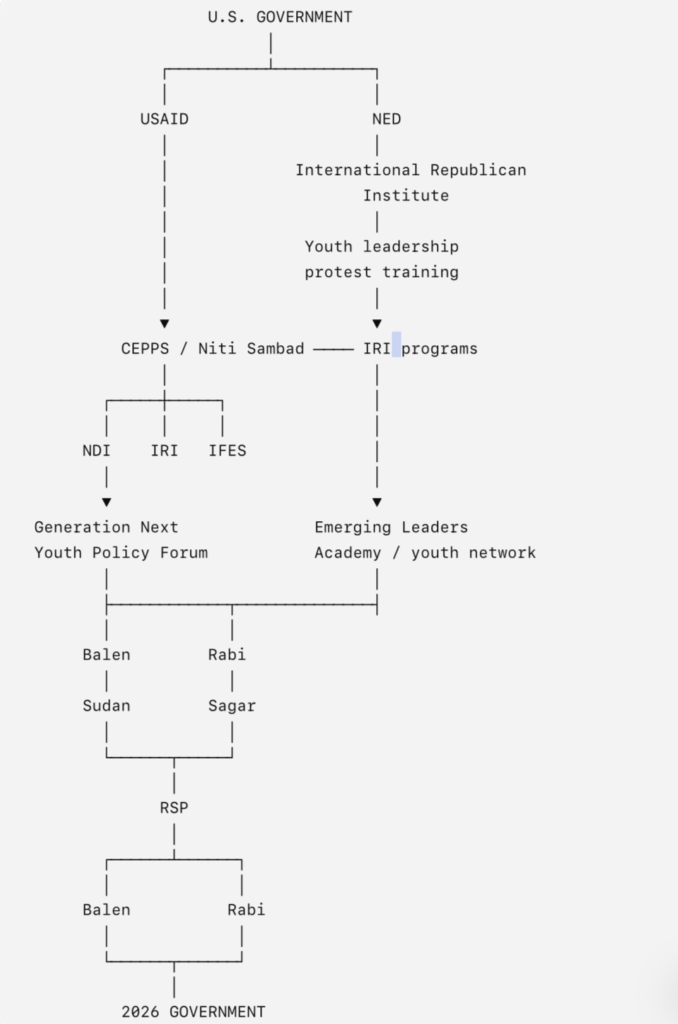
The most crucial discovery made to date:
🔴 Level 1 — Direct documentary evidence
CEPPS had named Balen, Rabi, Sudan and Sagar “catalytic civic leaders” it planned to assist — and indeed, it did.specifically, CEPPS referred to Balen, Rabi, Sudan and Sagar as ‘catalytic civic leaders’ it would support — and in fact, it did. – WordPress image
🔴 Level 2 — Direct documentary evidence and obviously cited.
CEPPS/NDI intended to identify emerging leaders, make them visible in the public most of the time and train them in Communication in the social media, PR and public speaking and leadership. Selection included prior engagement and consultation with USAID/CEPPS/USAID partners. – WordPress images
🔴 Level 3 — Direct Documentary evidence that is readily recognized by the reader and to which they readily refer.
IRI/NED provided separate funding for youth leadership initiatives on three fronts: political advocacy, protest management and strategic messaging and leadership development. –Goachronicle
🔴 Level 4 — Individual documentary evidence
Sagar Dhakal was an US Embassy Youth Council member and team leader of a US Embassy Civic Engagement Project.
It concludes with a strong circumstantial association:It culminates in a good circumstantial connection:
Balen, Rabi, Sudan and Sagar were then the focus areas for another new political dinosaur called RSP. – Oxford-Weidenfeld and Hoffmann
🟠 Level 6 — Investigative hypothesis
Often such programs may have helped build a cadre of political players crucial to RSP and the post-2025 political future.
Table of Contents
Most searched keywords: USAID Niti Sambad Nepal, Niti Sambad leaked documents, CEPPS NepalUSAID Nepal, USAID political influence Nepal, Niti Sambad CEPPS, Balen Shah USAID, Rabi Lamichhane USAID